



Verk is a job processing system backed by Redis. It uses the same job definition of Sidekiq/Resque.
The goal is to be able to isolate the execution of a queue of jobs as much as possible.
Every queue has its own supervision tree:
- A pool of workers;
- A
QueueManagerthat interacts with Redis to get jobs and enqueue them back to be retried if necessary; - A
WorkersManagerthat will interact with theQueueManagerand the pool to execute jobs.
Verk will hold one connection to Redis per queue plus one dedicated to the ScheduleManager and one general connection for other use cases like deleting a job from retry set or enqueuing new jobs.
The ScheduleManager fetches jobs from the retry set to be enqueued back to the original queue when it's ready to be retried.
It also has one GenStage producer called Verk.EventProducer.
The image below is an overview of Verk's supervision tree running with a queue named default having 5 workers.

Feature set:
- Retry mechanism with exponential backoff
- Dynamic addition/removal of queues
- Reliable job processing (RPOPLPUSH and Lua scripts to the rescue)
- Error and event tracking
First, add Verk to your mix.exs dependencies:
def deps do
  [{:verk, "~> 1.0"}]
end
and run $ mix deps.get. Add :verk to your applications list if your Elixir version is 1.3 or lower:
def application do
  [applications: [:verk]]
end
Add Verk.Supervisor to your supervision tree:
defmodule Example.App do
  use Application

  def start(_type, _args) do
    import Supervisor.Spec
    tree = [supervisor(Verk.Supervisor, [])]
    opts = [name: Simple.Sup, strategy: :one_for_one]
    Supervisor.start_link(tree, opts)
  end
end
Finally we need to configure how Verk will process jobs.
Example configuration for Verk having 2 queues: default and priority
The queue default will have a maximum of 25 jobs being processed at a time and priority just 10.
config :verk, queues: [default: 25, priority: 10],
              max_retry_count: 10,
              poll_interval: 5000,
              start_job_log_level: :info,
              done_job_log_level: :info,
              fail_job_log_level: :info,
              node_id: "1",
              redis_url: "redis://127.0.0.1:6379"
Verk supports the convention {:system, "ENV_NAME", default} for reading environment configuration at runtime using Confex:
config :verk, queues: [default: 25, priority: 10],
              max_retry_count: 10,
              poll_interval: {:system, :integer, "VERK_POLL_INTERVAL", 5000},
              start_job_log_level: :info,
              done_job_log_level: :info,
              fail_job_log_level: :info,
              node_id: "1",
              redis_url: {:system, "VERK_REDIS_URL", "redis://127.0.0.1:6379"}
Now Verk is ready to start processing jobs! 🎉
A job is defined by a module and arguments:
defmodule ExampleWorker do
  def perform(arg1, arg2) do
    arg1 + arg2
  end
end
This job can be enqueued using Verk.enqueue/1:
Verk.enqueue(%Verk.Job{queue: :default, class: "ExampleWorker", args: [1,2], max_retry_count: 5})This job can also be scheduled using Verk.schedule/2:
perform_at = Timex.shift(Timex.now, seconds: 30)
Verk.schedule(%Verk.Job{queue: :default, class: "ExampleWorker", args: [1,2]}, perform_at)A job can define the function retry_at/2 for custom retry time delay:
defmodule ExampleWorker do
  def perform(arg1, arg2) do
    arg1 + arg2
  end

  def retry_at(failed_at, retry_count) do
    failed_at + retry_count
  end
end
In this example, the first retry will be scheduled a second later, the second retry will be scheduled two seconds later, and so on.
If retry_at/2 is not defined the default exponential backoff is used.
Heroku provides an experimental environment variable named after the type and number of the dyno. It is possible that two dynos with the same name could overlap for a short time during a dyno restart.
config :verk, queues: [default: 25, priority: 10],
              max_retry_count: 10,
              poll_interval: {:system, :integer, "VERK_POLL_INTERVAL", 5000},
              start_job_log_level: :info,
              done_job_log_level: :info,
              fail_job_log_level: :info,
              node_id: {:system, "DYNO", "job.1"},
redis_url: {:system, "VERK_REDIS_URL", "redis://127.0.0.1:6379"}It's possible to dynamically add and remove queues from Verk.
Verk.add_queue(:new, 10) # Adds a queue named `new` with 10 workersVerk.remove_queue(:new) # Terminate and delete the queue named `new`Verk's goal is to never have a job that exists only in memory. It uses Redis as the single source of truth to retry and track jobs that were being processed if some crash happened.
Verk will re-enqueue jobs if the application crashed while jobs were running. It will also retry jobs that failed keeping track of the errors that happened.
The jobs that will run on top of Verk should be idempotent as they may run more than once.
One can track when jobs start and finish or fail. This can be useful to build metrics around the jobs. The QueueStats handler does some kind of metrics using these events: https://github.com/edgurgel/verk/blob/master/lib/verk/queue_stats.ex
Verk has an Event Manager that notifies the following events:
Verk.Events.JobStartedVerk.Events.JobFinishedVerk.Events.JobFailed
One can define an error tracking handler like this:
defmodule TrackingErrorHandler do
  use GenStage

  def start_link() do
    GenStage.start_link(__MODULE__, :ok)
  end

  def init(_) do
    filter = fn event -> event.__struct__ == Verk.Events.JobFailed end
    {:consumer, :state, subscribe_to: [{Verk.EventProducer, selector: filter}]}
  end

  def handle_events(events, _from, state) do
    Enum.each(events, &handle_event/1)
    {:noreply, [], state}
  end

  defp handle_event(%Verk.Events.JobFailed{job: job, failed_at: failed_at, stacktrace: trace}) do
    MyTrackingExceptionSystem.track(stacktrace: trace, name: job.class)
  end
end
Notice the selector to get just the type JobFailed. If no selector is set every event is sent.
Then adding the consumer to your supervision tree:
defmodule Example.App do
  use Application

  def start(_type, _args) do
    import Supervisor.Spec
    tree = [supervisor(Verk.Supervisor, []),
            worker(TrackingErrorHandler, [])]
    opts = [name: Simple.Sup, strategy: :one_for_one]
    Supervisor.start_link(tree, opts)
  end
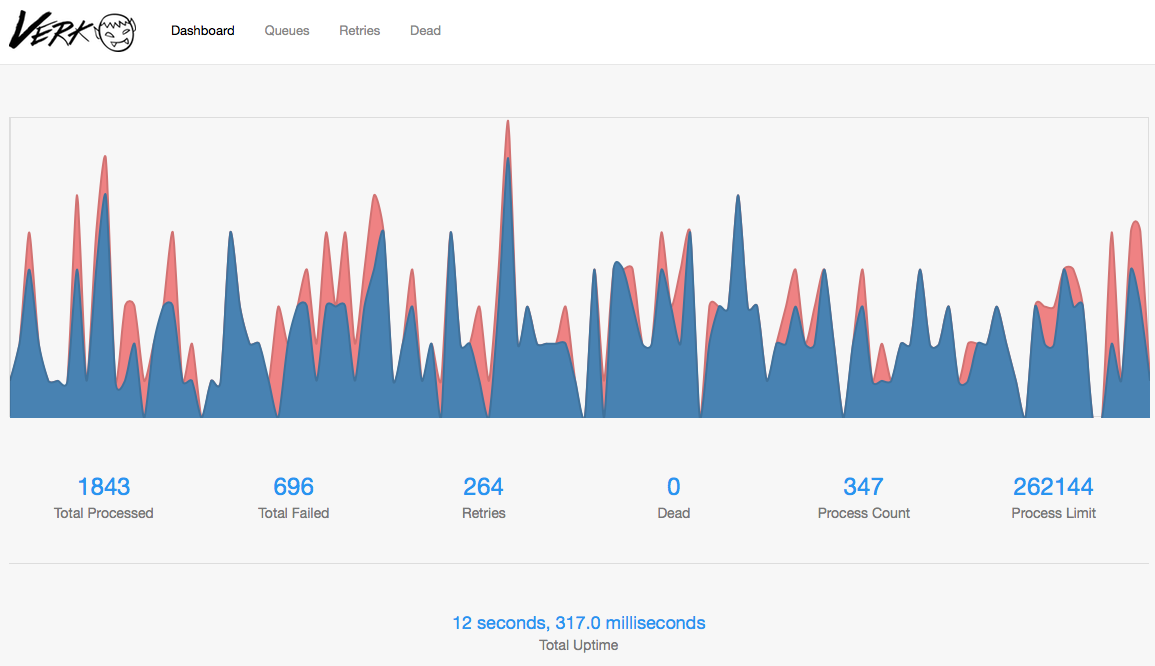
endCheck Verk Web!
Initial development sponsored by Carnival.io